
A Lexid devblog, filed from the middle of the decision, not the far side of it. Not from the Rumorevenant. Nobody at Lumen Eyrie Academy was consulted, and the enchanted ink had the night off.
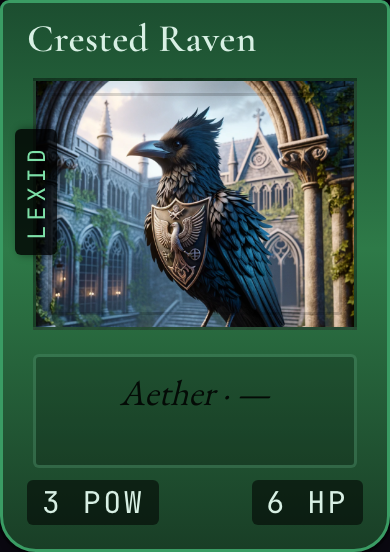
Note: right now we're generating card illustrations using a local Stable Diffusion running on a laptop powered by 100% renewables mix, at only 25W / hr, about 1/2000th of a commercial image generator. We are preparing a crowdfunding campaign to replace all AI 'illustrations' with human art. This is really important to us.
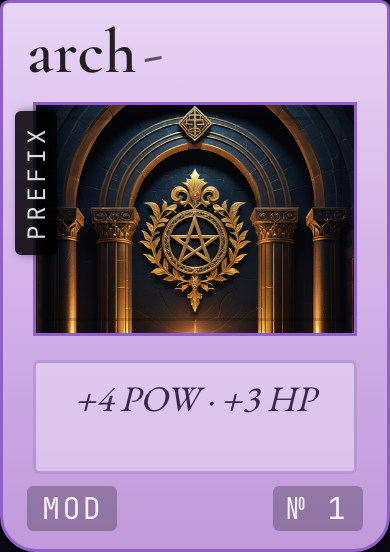
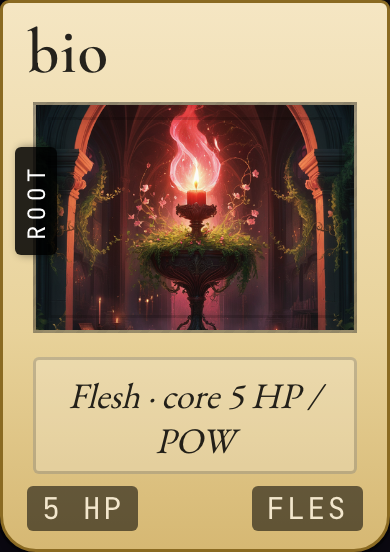
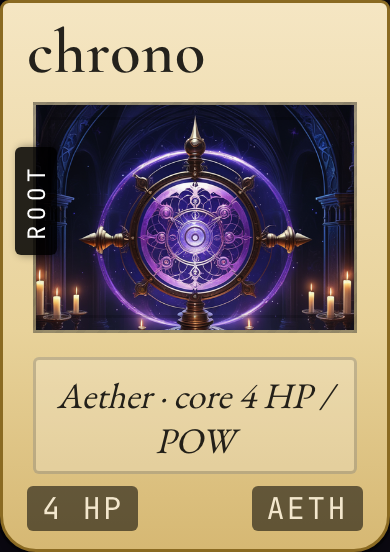
Most card games enjoy a quiet little luxury they never think to be grateful for: one card, one painting. Somebody illustrates the Fire Dragon, that illustration lives on the Fire Dragon forever, and every player who draws it sees the same handsome lizard. The art budget is finite because the card list is finite. It is a very sensible way to run a railroad.
Lexid declines this luxury on purpose, which is the polite way of saying we did it to ourselves.
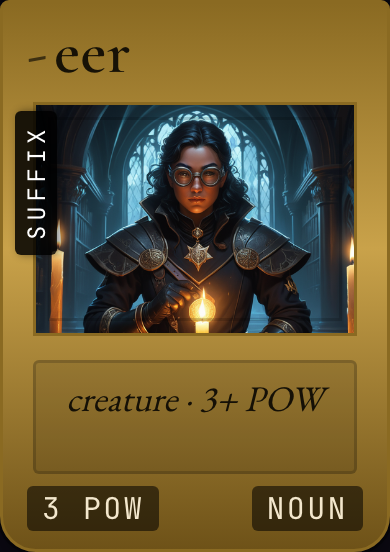
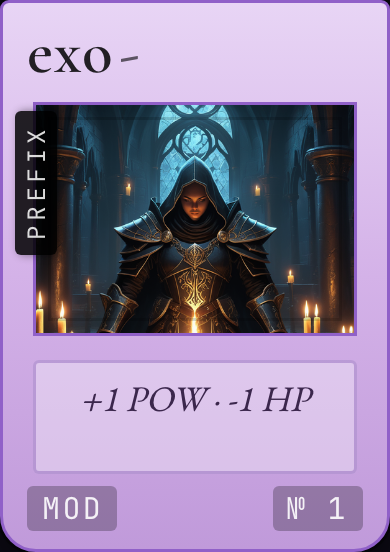
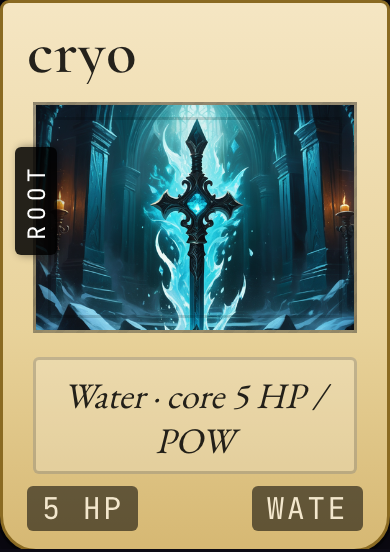
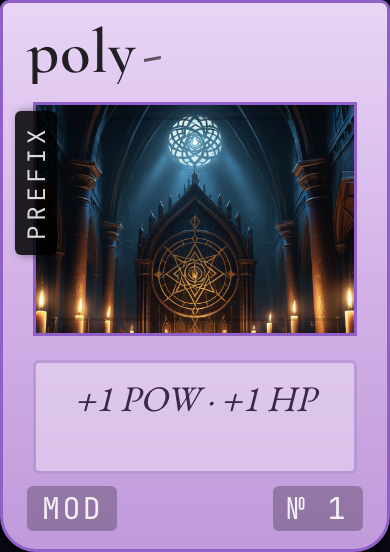
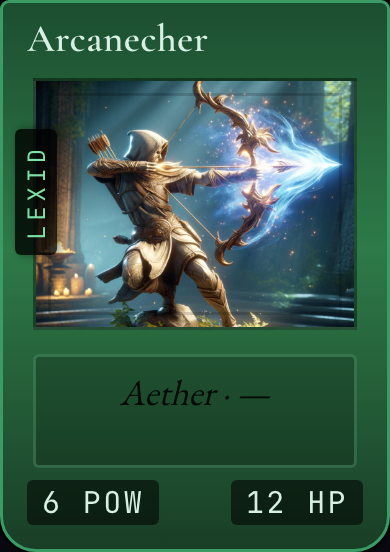
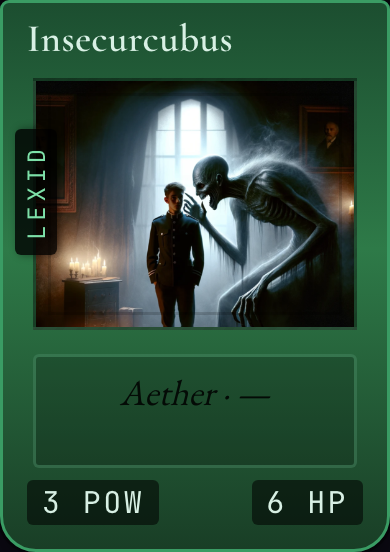
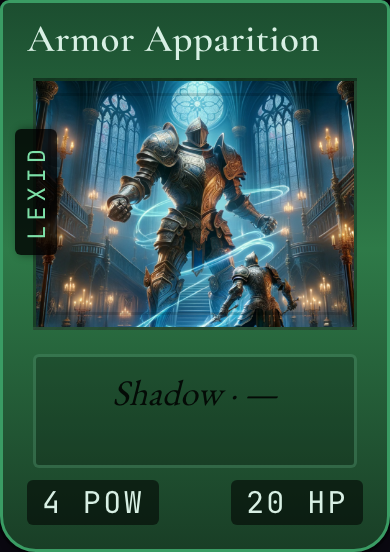
In Lexid you do not draw pre-made cards. You forge them out of language. A card (a "wird," and yes the misspelling is load-bearing) is built from morphemes the way a word is built from parts: up to four prefixes, a root, and up to two suffixes. pyromancer. super-pyromancer. hyper-arch-pyromancer-ling, which is either a powerful spellcaster or a very intense toddler, depending on your reading.
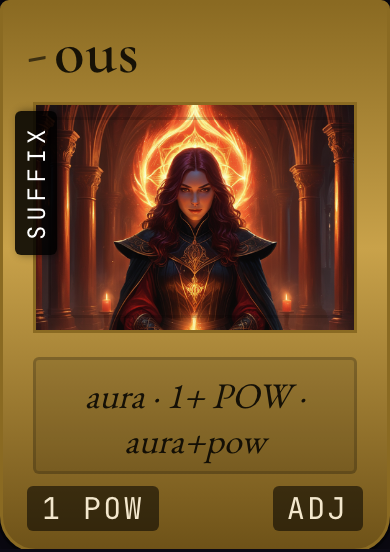
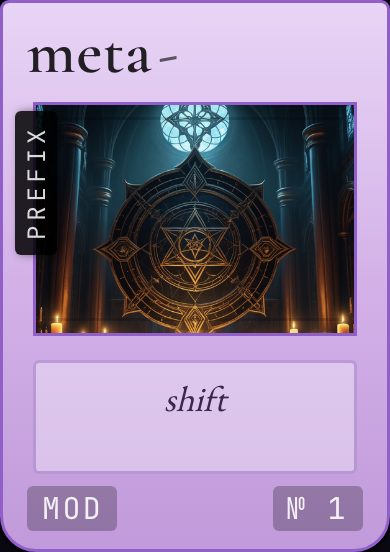
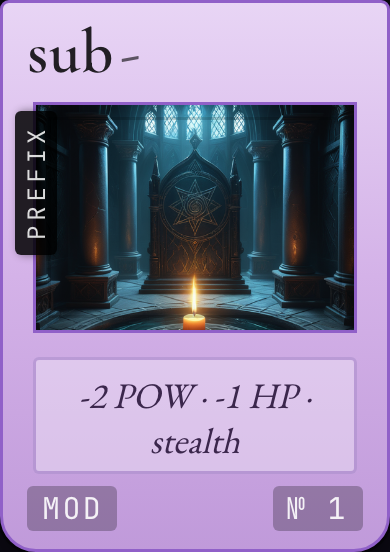
Do the combinatorics and the number stops being friendly. Four prefix slots from a pool of eighteen, a root from thirty-one, two suffixes from forty. The space of possible wirds is in the tens of millions. No artist is painting tens of millions of cards. No image generator is either, and if one offered to, we would gently suggest it lie down.
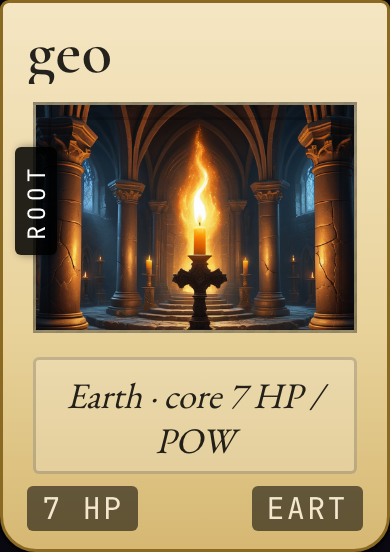
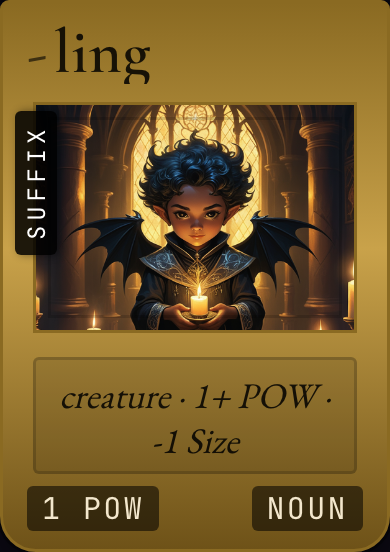
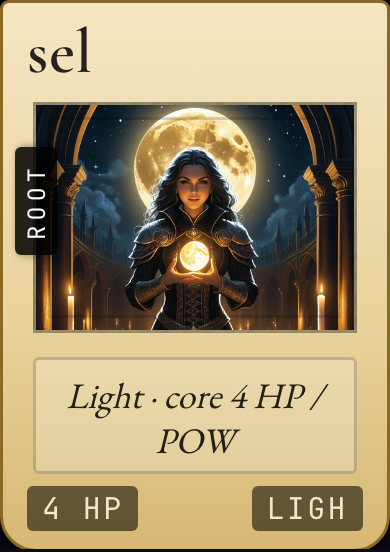
So the question that has eaten more of our design hours than any boss fight: how do you give every forgeable word its own face, without painting a number of faces best described in scientific notation?
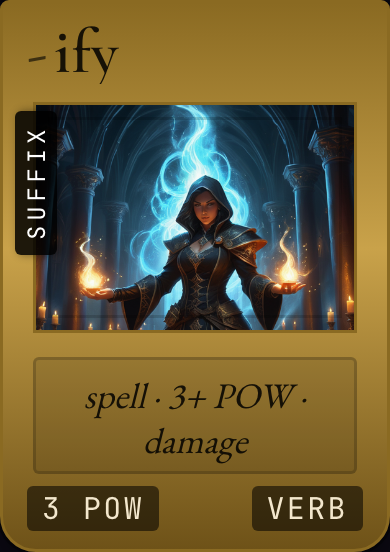
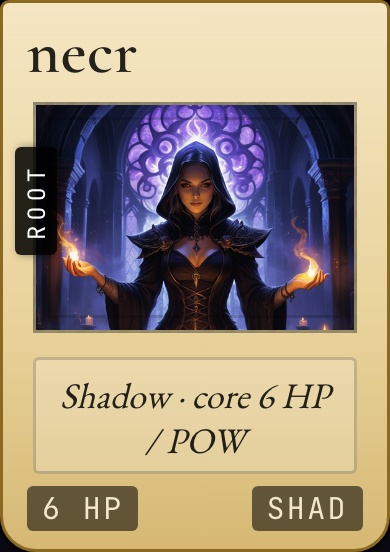
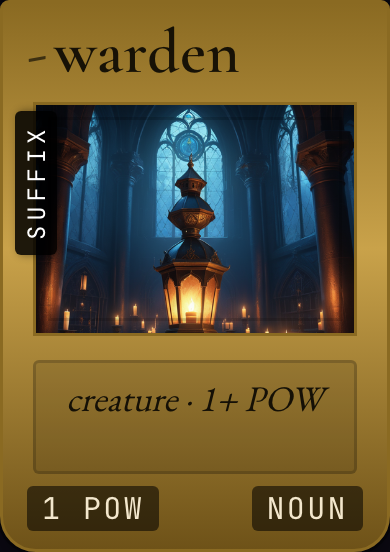
This is the most interesting problem in the game, and at the moment it is also an unanswered one. We are standing at the fork, not walking away from it. That distinction matters more than usual here, because this is exactly the kind of decision that looks like a render-pipeline choice and is secretly an architecture choice. Pick a family, build the infrastructure it demands, ship a few hundred wirds through it, and you have quietly poured a foundation. Foundations are wonderful right up until you want the house somewhere else. So this post is us thinking out loud on the record, before any concrete sets.
Here is how we have at least narrowed the ground.
Two reframes, before any technology shows up
The first useful move was noticing that the scary question was the wrong question. Two changes of framing do most of the work, and neither commits us to anything, which is our favorite kind of progress.
One: you never need the millions. You need the ones people actually make. The space of possible wirds is enormous. The space of wirds a real human actually forges, looks at, and grows fond enough of to keep is tiny by comparison. Dozens to low hundreds per player. And across everybody playing, the good combinations repeat constantly, because a satisfying word is satisfying to more than one person. Independent players keep arriving at the same pyromancer and feeling clever about it, which is allowed.
That reframes everything. The job was never "render the millions." The job is "render the handful someone actually summons, once each, and then have the basic decency to remember it." Stated that way, generating art on demand goes from impossible to merely an engineering problem, which is the best downgrade in our line of work.
Two: the picture can be built the way the word is built.
Lexid is a game about assembling words from parts. So the most honest art system is probably not a painting at all. It is a visual grammar, where you read the picture the same way you read the wird. The root is the core. The suffix is the form, or role. The prefixes are the modifiers piled on top.
Once the picture is assembled from the same pieces as the word, the combinatorial explosion stops being the villain and starts being the entire point. Every wird looks unique because it genuinely is a unique assembly, and a player can learn to read a card at a glance, the way they already read its name. The curse, it turns out, was the feature wearing a bad disguise.
These two we are fairly confident in. What follows, the actual rendering technology, is the part still very much in play. It comes in roughly five families. Read each one with the same question in the back of your mind that we do: if we are wrong, how expensive is it to leave?
Family A: assemble from the parts (the deterministic composite)
Take the individual morpheme artworks and layer them into one image. This is the ancient logic of heraldry, of trading-card-game token assembly, and of every NFT project that ever stacked a hat onto an ape.
The strongest version we call vessel and fill. The suffix defines a silhouette: a robed figure for -mancer, a blade for an action suffix, a shield for -shield, a skyline for -city, a bare aura for an adjective. The root is then poured into that shape as the elemental fill. So pyromancer is fire, masked into the outline of a robed caster. Prefixes add tints, glows, and ornament on top.
The lovely part is that this runs entirely on the player's own machine by compositing art we already have. No server, no waiting, works in airplane mode/offline, scales to infinity, and is perfectly deterministic, meaning the same word always yields the same picture. Cost per card: roughly nothing, which is our price range.
The catch: it can read a touch mechanical, four stacked prefixes risk looking like a charm bracelet that lost a fight, and it will never be one cohesive painted scene. The lock-in is light, though. The thing it commits us to is mostly a folder of layer art and some compositing rules, both of which are cheap to revise or abandon.
Family B: draw it from a seed (procedural synthesis)
Take the wird's identity, hash it into a number, and let that number draw a unique artifact with an algorithm. No image files at all, which makes the download tiny and the storage bill imaginary.
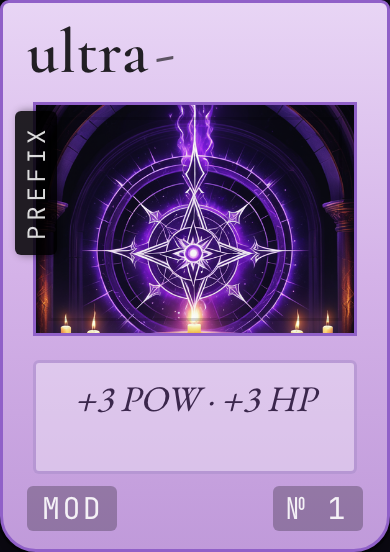
Picture arcane sigils: rune lattices and flow fields where the palette comes from the element, the complexity from how many prefixes you stacked, the symmetry from the suffix. Every word receives its own true-name glyph. A fancier version pushes the whole thing onto the GPU as a single shader, so the art is animated, alive, and infinite for the price of some math. And because the game already runs a particle and aura system, the "art" could simply be a living aura, each morpheme contributing its own signature flourish.
Strengths: genuinely infinite, unique-feeling, animatable, and deeply on theme for a school of linguistic magic. The weakness is honesty in the other direction. It denotes rather than depicts. Done with care it is a glyph. Done carelessly it is a screensaver. The hidden cost is that the debt here is authored into the algorithm itself. Once a hash seeds a thousand players' glyphs, changing the generator silently restyles everyone's collection, so the lock-in is subtle but real.
Family C: render the real subset on demand (diffusion, then cache)
Here is where reframe number one would collect its winnings. Use an image generator the first time a wird is ever forged, then cache that result forever, filed under the word's identity.
The forging moment is already a deliberate, ceremonial "I made this" beat in the game, which makes it the natural place to quietly generate once and store. Every morpheme already carries a tuned scrap of prompt text, so you concatenate them (root as subject, prefixes as intensifiers, suffixes as form and role) into a single prompt, and optionally pin the generator to the Family A composite so it respects the layout instead of wandering off to paint whatever it likes. Cache the result on a shared server, and the popular wirds get generated exactly once for the entire playerbase. The long tail pays for itself by mostly never showing up.
Strength: real illustrated art, on theme, reusing work already done. This is also the family with the heaviest anchor. It is too slow to live inside combat, it needs a server and storage that then need to exist forever or every cached painting evaporates, its quality has opinions of its own on any given day, and it cannot run offline. Of the five, this is the one most likely to become legacy debt we are stuck maintaining, precisely because players will grow attached to the specific images it produced. You cannot casually regenerate someone's favorite card.
Family D: change the subject (denote, do not depict)
A quieter idea that we keep being unable to dismiss: make the art about the word, not about a creature. An illuminated-manuscript treatment of the wird's own lettering. An alchemical recipe diagram of its morphemes. A constellation chart wiring its parts together. This sidesteps the entire "depict tens of millions of distinct beings" obligation, and for a magic school built on language it might be the single most on-brand option we have. It can be fully procedural and still be genuinely beautiful, which is a rare combination of cheap and pretty. Its lock-in profile is as light as Family A, which is a thumb quietly resting on this side of the scale.
Family E: use different fidelity for different moments (the tiered hybrid)
No rule says one technique has to carry the whole game. Use something cheap and instant for the high-churn moments, the cards flickering past in the heat of a battle, and reserve a richer generated "hero portrait" for the wirds a player forges and collects. Swap it in progressively, like a photo developing in a tray, once it is ready. The eye forgives a placeholder it watches improve.
The honest asterisk: a hybrid does not dodge the hard choices, it signs up for several of them at once. You inherit Family A's layer rules and Family C's server bill and the seam where the two have to agree on what a card looks like. Sometimes that is the mature engineering answer. Sometimes it is two unfinished systems in a trenchcoat. Which one it is depends entirely on the connective tissue below, and we do not yet have the conviction to say.
How to tie it together: one grammar, defined once
Here is the load-bearing insight under all of it, and the reason the fork is not as terrifying as the foundation metaphor suggests. Whichever rendering technology wins, we can define the visual grammar a single time:
- Root sets the core subject, the base element, and the palette.
- Primary suffix sets the form.
- Agent suffixes become humanoid silhouettes, -ling a small creature
- Action suffixes a blade, -shield a shield
- Place suffixes architecture
- Adjectives a bodiless aura.
- Second suffix adds an accent motif layered onto that form.
- Prefixes stack the modifiers: a golden uplight, motion streaks, a UV rim light, a crown, a long shadow, a ghosted double.
Define that mapping once and it can quietly drive the layer rules of a composite, the shader parameters of a procedural sigil, and the prompt grammar of a diffusion model. That is the one piece of work we are comfortable starting before the fork is settled, because it pays off down every branch. If there is a way to buy ourselves optionality on a decision this load-bearing, it is to invest in the part that survives whichever road we take.
Where we actually are
Not landed. Leaning, at most, and keeping our weight on the back foot.
The instinct in the room points toward a tiered hybrid built on that shared grammar: a deterministic vessel-and-fill composite as the always-instant, always-offline baseline, with on-demand diffusion reserved for forged "hero" cards and the whole house style nudged toward the sigil and illuminated-manuscript end, so the gloriously abstract combinations (your super-meta-arch-something-ous) never have to pretend to be a creature. They would get to be a magnificent seal instead, and they would wear it well.
But leaning is not choosing, and a few questions still have to answer themselves before we pour anything:
- Depict or denote. Should a wird's art aim to look like an illustrated creature, or is an arcane seal just as satisfying and far easier to live with? This single answer quietly eliminates two of the five families.
- How many wirds does a player really see. High battle churn rewards the instant families. A small curated collection makes the expensive on-demand path suddenly affordable.
- Offline, or online only. This one is close to a verdict on its own. If the game must work on a plane, Family C can never be load-bearing, only a bonus tier riding on top of something else.
- Animated, or static. Animation makes the procedural and aura routes punch well above their cost. Static narrows the field.
- How strict is determinism. If the same wird must look identical for every player forever, that pushes hash-seeding into everything and quietly raises the cost of ever changing our minds.
So this is the genuine state of play: two reframes we trust, one grammar worth building now regardless, five families on the table, and a deliberate refusal to pour the foundation before we know which house we are building. The hardest art problem in the game may have a graceful answer hiding inside it, the one where we stop trying to paint the language and let the language paint itself. We just want to be sure we have found it before we let it set, because this is precisely the kind of road where the wrong turn does not feel wrong for about six months, and then never stops.
More once the concrete is closer to ready. For now, we are content to stand at the fork a little longer than is strictly comfortable. It is cheaper than standing somewhere else holding a broken, hardened slab.
Leave a Reply